"I should questionless be fortunate"
How deep is Bassanio's love for Portia?

Previously, on actserious.substack.com . . .
Antonio - the eponymous Merchant of Venice is in love with Bassanio, a hustler whose youth and charm has wheedled a considerable amount of money from Antonio and others to give him a life of ease. Now Bassanio wants even more money in order to woo Portia. Her primary attraction is that she is rich; as her husband he can use her wealth to pay back Antonio. The fact that she is beautiful is a welcome bonus.
Now read on . . .
Does Bassanio love Portia as the play opens? He confesses that if he should win Portia’s hand he would “questionless be fortunate”, but does he mean fortune as in rich or fortune as in happiness? Almost certainly the former. Money and status remain Bassanio’s priorities throughout the first half of the play as he brings Antonio and Shylock together to get the money he needs, hires as a servant Launcelot Gobbo, whom he can scarcely afford to pay, welcomes Gratiano on his coming journey to Belmont, and prepares to dine with Antonio and Shylock. Do his thoughts turn to love or Portia at any time? We suspect not, since neither that word nor her name passes his lips at any time.
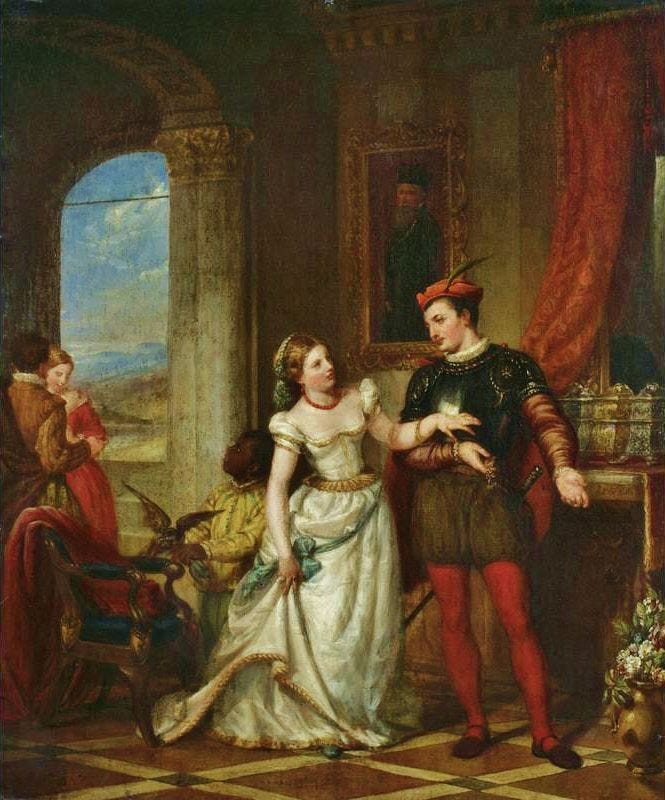
When Bassanio departs for Belmont he says he will hurry back to Venice but Antonio urges him to “be merry and employ your chiefest thoughts to courtship.” This brief exchange suggests that Bassanio is more concerned with Antonio than with Portia and that he is beginning to have remorse over the strange contract - the pound of flesh - that his friend has committed himself to his behalf. Meanwhile it is Antonio who talks of Bassanio’s - presumed - love for Portia rather than Bassanio himself, evidence of the older man’s concern for the younger man’s future.
---------------------
As time goes by
Three months pass between Antonio’s signing of the fateful bond and the day it falls due. Assuming Bassanio leaves Venice within a day or two of receiving the money he has asked for, how long does it take to get to Belmont? When news comes to Belmont that Antonio’s ships have foundered, how quickly does Bassanio get back to Venice? How long does Antonio languish in gaol before he comes to court? How much time does Portia need to get her message to Bellario in Padua and get the response? It appears that three months pass in Venice while probably less than a week passes in Belmont. (When Portia begs Bassanio to “pause a day or two”, it suggests that they have not been long in each other’s company.) Rather than work out a geography and timeline for these events, let us invoke dramatic licence and assume that time in Venice passes more quickly than in Belmont, so that while two or three leisurely days pass on Portia’s estate, three months fly by in the city of canals.
---------------------
In Belmont no sooner has the Prince of Arragon failed to choose the correct casket than it is announced that a new suitor awaits. Until now, all who have sought Portia’s hand have pursued wealth and status rather than love and from that perspective Bassanio is but another contender in a long line. Yet with the news that a handsome stranger is at the door, the atmosphere suddenly changes. The servant describes him (we guess it is Gratiano) as an “ambassador of love”; Portia calls him “Cupid’s post” and Nerissa begs the lord of Love to let it be Bassanio.
Love - one of the strongest and vaguest words in English or any other language, covers a host of emotions from the faintest affection to the most intense jealousy. At this point it is not love we are witnessing but love’s forerunner, desire - and even then desire is for the image in the mind rather than for the individual that the image represents. What we now want is to witness the next step - when Portia and Bassanio come face to face and eyes open and hearts beat and words of wonder tumble from their mouths with the same intensity as Romeo and Juliet when he beholds her on her now mythical balcony and that long fall into love begins.
But we are disappointed; Shakespeare deprives us of that spell-binding moment. Before either ambassador Gratiano or suitor Bassanio enters the scene, we are hauled back to Venice to learn of Antonio’s growing misfortunes. When we return to Belmont time has passed, although whether an hour, a day or a week is unclear.
No matter. We may have missed that first meeting (we do not count that time when Bassanio came with the Marquis of Montferrat) but we can see that each is now smitten with the other. Portia begs Bassanio to tarry before he comes to the caskets lest she lose his company, while Bassanio, uncertain of his fate, lives “upon the rack”. What are his emotions now? Having met Portia, has he lost all interest in her money - his earlier priorities overturned with her beauty now paramount and her wealth a welcome bonus? Or is he merely acting the role of the besotted lover to get the ordeal of the caskets over and either get his hands on her wealth or flee from Belmont, metaphorical tail between his legs?
Let us be charitable. As he contemplates the caskets Bassanio’s rejection of gold and silver can be taken as rejection of his earlier values. His joy on finding her portrait and his speech on receiving her ring now ring (forgive the pun) with integrity. We believe that he truly loves Portia and that emotion is echoed and underlined by Gratiano’s betrothal to Nerissa.
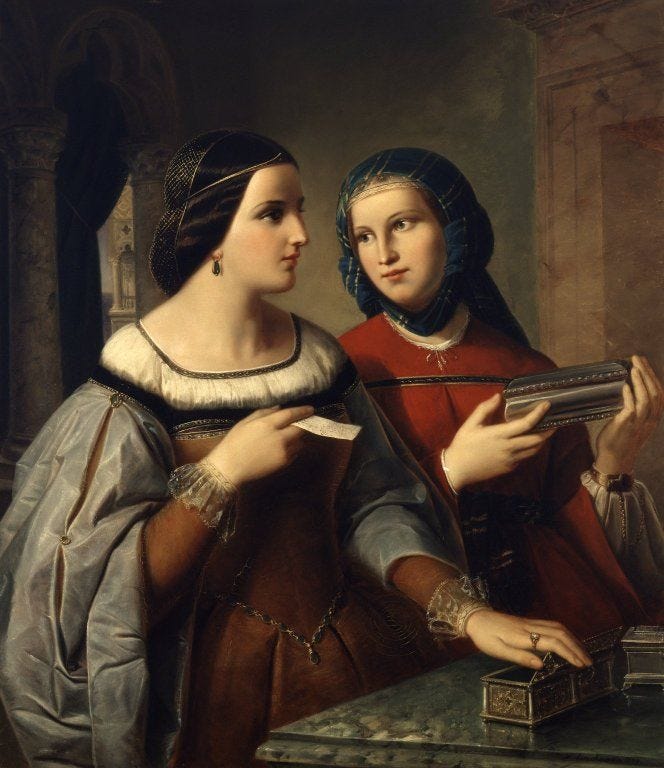
The Bassanio we see now has moved on from the confident hustler we first met. He has succeeded in his quest; he will repay Antonio’s debt (there’s a question about who control’s Portia’s money that we may yet look into) and live happily in Belmont. But immediately comes news that Antonio’s bond is forfeit and he confesses to Portia that his greed has placed his dear friend in danger.
What would a hero do at this point? He would surely rush back to Venice to save the day and his friend’s life, through violence, bribery, trickery or some other noble or ignoble action. Is that what Bassanio does? No. He may have won Portia’s hand but until they are married he is still an impoverished bachelor, a braggart lacking the three thousand ducats that he presumes Antonio needs. Not only does he have no money, he has no initiative. Whatever feeling he has for Antonio, his will is paralysed. It is Portia who immediately takes the situation in hand. Marry me, she commands him, then take as much money as you need and rush to Venice to save your friend.
Once again our opinion of Bassanio has changed. We first saw him as greedy, then as deeply in love, now as weak of will. What more of his personality shall we see?
When we next come across him, in court, he at first appears unfocused, exchanging barbs with Shylock, then offering the moneylender twice the sum borrowed and promising Antonio: “The Jew shall have my flesh, blood, bones and all ere thou shalt lose for me one drop of blood.” When Portia, who has arrived in disguise, takes charge of the proceedings, he is calmer. To placate Shylock, he offers ten times the borrowed sum “on forfeit of my hands, my head, my heart,” then turns to ask Portia: “to do a great right (free Antonio), do a little wrong (deny Shylock his pound of flesh).”
---------------------
What’s thy pronoun?
Shakespeare was writing at a time when the distinction between “thou/thee/thy/thine” and “you/you/your/yours” was breaking down and “you” was becoming more universal. As is still common in many languages, “thou” was for intimates, family members, inferiors and God, while “you” either referred to more than one person or was a mark of respect for an individual - an equal or superior. Throughout the play Antonio and Bassanio use “you” with each other (as Bassanio does with Portia) except twice in the court scene, when Bassanio says “thou” and “thy” to Antonio - words that come from the heart.
---------------------
Portia refuses to pervert the course of justice. Bassanio stays quiet until it seems Antonio must face the knife. When Antonio declares his love for him, Bassanio, distraught, says he would sacrifice his wife’s and his own life to save Antonio’s. This is raw emotion, but what emotion is it? Love? Remorse? He is face to face with the man who has loved him for much longer than the wife he has only just married and abandoned; if forced to choose between the two, it is Portia’s death that Bassanio says he would choose, not Antonio’s.
Whether this is bluster and he would stay with that choice if the knife was pointing at his own breast as well as Portia’s to allow Antonio to walk free, we do not know, although we suspect his own life would be the priority. If one life - Antonio’s or Portia’s - was required to satisfy Shylock’s bond, what would Bassanio’s choice be? If wealth alone, Bassanio would surely sacrifice Antonio; if emotion determined the choice, I suspect he would sacrifice his new wife to save his old friend. This is not to condemn whatever choice he might make, only to wonder what would weigh in his mind should such a terrible situation arise.
We are not quite finished with Bassanio. There is the incident of the rings (his and Gratiano’s). It takes but a little cajoling for Portia-in-disguise to gain the ring that she gave him on their wedding day and with which he swore he would never part. Why does he give it to this stranger who has performed a valuable service but who he will never see again? We can only conclude that Bassanio’s will is weak - something we already knew - and he is charmed by this androgynous figure who on a subconscious level no doubt reminds him of his wife. When later in Belmont Portia teases him to confess that the ring has gone, his excuses remind us of a wayward child begging forgiveness from an indulgent parent hiding their amusement.
With that last issue resolved the play comes to an end and we can ask ourselves how deep is Bassanio’s love for Portia? His hustling days are surely over as he has reached his goal - wealth and status as Portia’s husband. Furthermore, his wife is beautiful, resourceful and intelligent - the last two qualities making up for those which he lacks. Whether his love is deep or broad or both we cannot say at this early stage of their marrage but we are sure it is sincere, as sincere as his affection, and perhaps love, for the Merchant he leaves in his past and who, we hope, will find another young man to love.
Does Portia love Bassanio? Yes, but she has no illusions about her new husband. He is handsome, young and good-natured - but also lazy and weak-willed. Still, whatever his faults he is immeasureably better than the fops, fools and worse who once hoped to claim her. Luckily, she is strong enough for both of them and, contrary to custom, will surely keep control of her husband’s purse-strings as well as his heart. It looks like being a successful marriage and we wish them well.
Next post: why does Antonio hate Shylock?
---------------------------
These musings (this is the fourth in the series) began more than two years ago when I began writing A Pound of Flesh, a reimagining of The Merchant of Venice in which Portia does not come to Venice and events end in tragedy. The three-week run of a shortened version of the play, which combines Shakespeare’s original text with language and imagery in his style, at the Edinburgh Fringe 2025 brought in five- and four-star reviews. It is my ambition to see a second run produced in 2026 or 2027. There is a trailer on youtube: