Isn't that queer?
Remembering Gay Sweatshop

The other day on ebay I snapped up a rare and battered copy of Gay Sweatshop: Four Plays and a Company, introduced and edited by Philip Osment (Methuen, 1989, ISBN 0-413-61380-1).
I saw several Gay Sweatshop plays when living in London in the late 1970s. As a young, middle-class gay man with vague left-wing ideals that owed more to hippiedom than to Marxism, I considered it my duty to support any group promoting Gay Liberation. And so in dingy fringe theatres (the same theatres I would act in many years later) I watched earnest dramas that insisted that no matter how severely society oppressed us, we homosexual men and women could nevertheless transform society and break free.
I heard, understood and sympathised with the constantly repeated message but I did not feel it. I had had no experience of homophobia and my sexual attraction to men was merely a minor inconvenience in that it could not be revealed to my family. Otherwise my homosexuality was an advantage; it enabled me to find sexual partners with ease and it relieved me of the burden of (heterosexual) marriage and eventual parenthood. I knew that Gay Sweatshop’s productions were of vital importance to its members and its audience but they were of only intellectual interest to me.
I soon lost interest in the company, unaware that as it developed it tackled broader issues than those faced solely by gay men. An integral-but-separate group of lesbians joined and issues of class and other marginalised groups were addressed. The company’s persistence was not always well-received, particularly by left-wing activists - usually men - who saw homosexual liberation as a distraction from their cherished socialist goals.
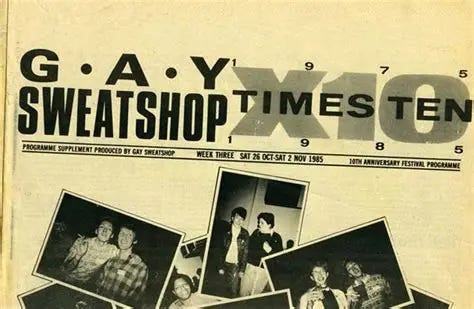
At its peak in 1985, seventeen plays out of a submitted ninety-six were presented at the Gay Sweatshop Times Ten Festival at the Drill Hall in London. Staged readings and full productions by GS and other gay theatre groups covered, among other topics, “gay teachers, the problems facing young lesbians and gays, lesbian custody, hidden disabilities, the experiences of Black lesbians, gay people’s relationships with their families and AIDS”.
As the decade continued, with the emergence of HIV/AIDS and consequent AIDS hysteria, and by the enactment of the infamous Clause 28 preventing local authorities from “promoting” homosexual activities, the company continued to create and tour new works. Again and again they met hostility from the media, local authorities, public figures and even some audiences - and again and again they were rewarded by cheers and tears of gratitude from the majority of audiences they played to, who saw their lives vindicated and celebrated.
As with any theatre company, not every play Gay Sweatshop produced was successful, particularly when a script’s political message pushed good drama aside. Another problem came from working with heterosexual actors, which reached a crisis when one cast member drew attention to his wife and children in the play programme. Over the years the strains of working together and touring on a shoestring - grants from the Arts Council and others seldom, if ever, paid for accommodation - proved too much for some members. Nevertheless, the company continued in one format or another until it formally closed in 1997.
Nearly thirty years later, “gay” has mostly given way to “queer”. The emphasis has expanded from sexual orientation (who am I attracted to?) to identity & orientation (who am I? who am I attracted to?). As “gay” was narrowly defined, “queer” is broad, fluid, celebrating uncertainty and exploration. Unsurprisingly for a word with origins as an insult, “queer” considers itself marginalised, or it is marginalised or it marginalises itself (whichever is appropriate depends on your point of view); understandably it allies itself with other marginalised groups, such as the disabled / differently abled, ethnic minorities / global majority etc. (Ten years from now, who knows which, if any, of these terms will be acceptable?)
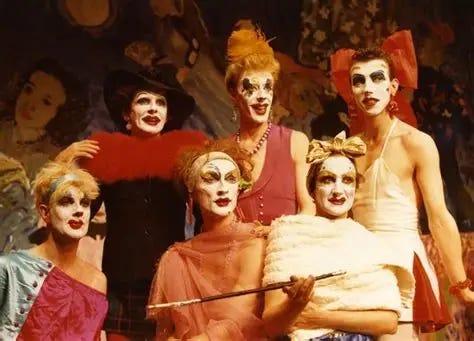
While Gay Sweatshop was almost unique in its time - only Bloolips, which focused on drag, achieved similar widespread recognition amongst gay men - today queer theatre is widespread. A quick Bing or Google search throws up many companies, producers, actors, etc, that call themselves queer. At each year’s Edinburgh Fringe, the word is a catch-all category that describes young men’s stories of coming out, young women’s stories of coming out, trans and non-binary stories of coming out; in almost every case sex and hostility and family and lovers and more are pulled into the mix.
The stories they tell are often powerful dramas of individuals taking control of their lives. They are almost always the stories of youth and the possibilities that youth offers. Queer theatre attracts large audiences, almost always the same generation, young men, women and non-binaries/agenders seeking and finding validation in other people’s stories, seeking and finding themselves.
Which brings me back to the beginning. Decades ago my privileged background allowed me to move on from Gay Sweatshop. Today, that privileged background, plus the advantage of age (unless you are old you are unlikely to understand the advantages that age can bring) sets me apart from queer theatre, both as audience and as creator of drama.
Many of the characters I create, previously in fiction, now in drama, are men attracted to other men. Sometimes that attraction is the core of the story; more often it is peripheral or it illustrates another point. In every case, however, I refuse to describe what I have written as either gay or queer. I do not want to limit people’s perception of what they see; nor do I want to turn away potential audience members who do not identify as gay or queer.
I know that most of my plays are not for everyone, but they are intended to entertain and to make people, of every age and background, think. I see myself in the tradition of all theatre, and queer theatre as an essential niche within that tradition. Long may it live, thrive and evolve.
Similar to "Christian theatre", "gay/queer theatre" treads the wafer thin line between art and propaganda. And can too easily fall the wrong side of it.