Prospero and the Baron
Frederick Rolfe: the man who would be Pope

If the writer Frederick William Rolfe (pronounced “Roaf”, 1860 - 1913) is remembered today it is for Hadrian VII, the only novel of his still in print.
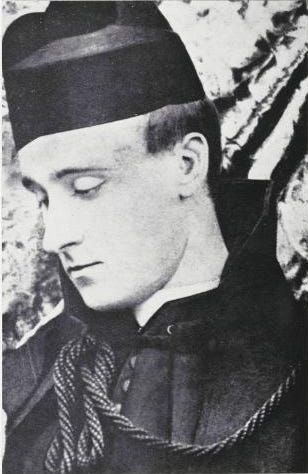
Rolfe was a complex character – eccentric, cantankerous and contradictory. A convert to Catholicism, his great ambition was to become a priest but his inability to conform to the mores of his colleagues led to him twice being expelled from seminary. His resentment of the clerics of the Roman church lasted all his life; he was convinced that not only should he be made a priest but only he had the moral authority to be Pope. From that belief - that fantasy - came Hadrian VII, in which an Englishman denied the priesthood for years is suddenly elected to the papacy.
Intensely proud, Rolfe refused all charity while living off loans which were seldom repaid. Strongly attracted to handsome young men, to prove his fitness for the priesthood he remained celibate for twenty years. With a deep longing for the Divine Friend with whom he could share life’s adventures and vicissitudes, he nonetheless alienated and quarrelled with almost all who came close to him. In early adult life a schoolteacher, painter and experimental photographer, his greatest talent lay in writing – a profession he claimed to loathe.
For a time he styled himself Baron Corvo, a title apparently granted by the Duchess of Sforza-Cesarini, an Englishwoman he met while studying in Rome. Although never ordained, he sometimes called himself Rev F W Rolfe. At other times he was Fr Austin or Fr Rolfe – the Fr conveniently interpretable as either Frederick or Father. Collaborating on two books he was Prospero. Other names were used in the frequent letters he wrote to newspapers.
Rolfe’s circumstances changed as frequently as his name. He spent most of his life in penury, convinced that a host of incompetent and malicious publishers, agents and lawyers were preventing him from earning a good and regular income as a writer. Often homeless, frequently hungry, he spent years in search of steady employment, shelter and friendship, chasing dreams and creating nightmares in cities and towns as far afield as Aberdeen and Christchurch, Holywell and London, Oban and Oxford.
In 1908 Rolfe, travelled to Venice and thereafter never returned to Britain. Despite frequent privations – at times enduring days of hunger and nights without shelter – Venice brought him a kind of peace. He wandered its streets, swam in its waters, sailed the lagoon and explored the outlying islands. Towards fellow Britons who crossed his path he maintained a characteristic disdain; it was with young gondoliers and stevedores that he found the closest companionship, both social and sexual, although never the elusive Divine Friend.
In March 1913 Rolfe moved to rooms in the Palazzo Marcello overlooking the Grand Canal. For a time he was enthused by his new surroundings, but his money problems returned, his health deteriorated and his mood was often despondent. On the last Saturday of October in good mood and apparent good health, he dined with a friend; the next afternoon his body was discovered alone in his room, the victim of a heart attack at the age of fifty-three.
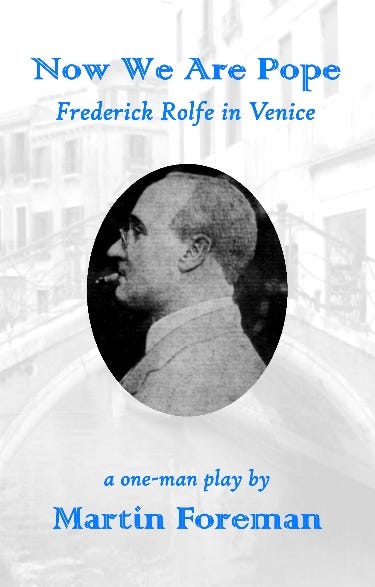
My 45-minute one-man play Now We Are Pope portrays Rolfe on the last day of his life, speaking to his unseen servant, looking back over his past and fantasising that he has indeed become Pope. It’s a challenging but rewarding role for an actor in his fifties, memorably created by Christopher Annus in a series of productions in London and Edinburgh in 2014. The script and rights are available through https://www.martinforeman.com/scripts-and-rights/.